Item.4 DL-ZLRA01 Refrigeration Cycle and Heat Pump System with HMI (Human-Machine Interface) Technical Document
1. Scope of Supply
The Contractor shall supply, deliver, install, test, commission, and hand over complete Refrigeration Cycle and Heat Pump Training System with Human-Machine Interface (HMI), including:
· Fully operational refrigeration and reverse-cycle heat pump system
· Programmable HMI touchscreen control system
· RFID power management system
· Complete instrumentation and control panel
· Standard accessories, tools, and documentation
The equipment shall be factory assembled, tested, and delivered ready for immediate instructional use.
2. General Description
The system shall be designed for advanced vocational training in refrigeration and heat pump technology. It shall allow:
· Operation in both forward refrigeration mode and reverse heat pump mode
· Practical wiring and electrical control circuit training
· Observation of refrigeration components and system states
· Performance analysis and comparison of cooling and heating cycles
· Calculation of COP (Coefficient of Performance) and EER (Energy Efficiency Ratio)
· Mollier diagram plotting and thermodynamic analysis
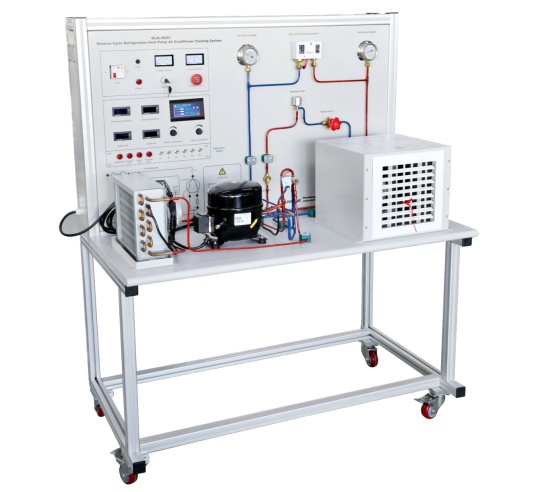
All main components shall be mounted visibly on the front panel for direct observation and operation.
Refrigerant shall be R134a or equivalent environmentally acceptable refrigerant.
3. Mechanical Construction
3.1 Training Bench Structure
· Heavy-duty aluminum profile and sheet-metal construction
· Approximate dimensions:
1600 (W) × 720 (D) × 1890 (H) mm
· Mounted on four (4) casters:
o Two (2) with brakes
o Two (2) without brakes
· Fully piped and electrically wired
· Copper pipes coated with anti-oxidation and anti-corrosion treatment
3.2 Component Layout
All major refrigeration components shall be mounted on the front panel, including:
· Compressor
· Condenser (with fan)
· Evaporator (with fan)
· Expansion devices
· Receiver and accumulator
· Four-way reversing valve
· Solenoid valves
· Pressure gauges
· Manual valves
· Sight glasses
Refrigeration piping shall be clearly arranged and accessible for observation.
4. Electrical Requirements
· Power Supply: Single-phase 220V ±10%, 50Hz
· Rated Current: 10A
· Earth leakage circuit breaker 16A
· Key switch (self-locking)
· Emergency stop button (self-locking)
· Overload protector 10A
· Analog voltmeter (0–250V)
· Analog ammeter (0–10A)
· Indicator lights (5 pcs)
5. Refrigeration and Heat Pump Components
The system shall include, at:
5.1 Compressor
· Capacity: 1/2 HP
· Voltage: 220V AC, 50Hz
· Refrigerant: R134a or equivalent
5.2 Condenser (with Fan)
· Single-phase 220V ±10%
· Mounted for full visibility
5.3 Evaporator (with Fan)
· Single-phase 220V ±10%
5.4 Four-Way Reversing Valve
· 220VAC electronic type
· Operating pressure: 2.5 MPa
· Min operating pressure: 0.25 MPa
· Discharge pipe: 3/8"
· Suction/coil pipe: 5/16"
5.5 Expansion Devices
· Pressure expansion valve (R134a or equivalent)
· Thermostatic Expansion Valve (TEV):
o Operating range: -40°C to +10°C
o Ambient temperature: -40°C to +90°C
5.6 Liquid Receiver
· Capacity: 1 liter
5.7 Solenoid Valves
· Quantity: 9 pcs
· Voltage: 220V ±10%
· Welded connection, Φ6 mm (Minimum)
5.8 Heat Pump Filter-Driers
· DN 50
· Port: 1/4" (2 pcs)
5.9 Pressure Controllers
· High-pressure switch: 110–430 psi
· Low-pressure switch: 0–80 psi
5.10 Sight Glasses
· Welded type (6 pcs)
6. Human-Machine Interface (HMI)
The system shall include a programmable touchscreen HMI with the following minimum specifications:
· Touchscreen operation
· Memory: SRAM 128 KB
· Compressor start/stop control
· Refrigeration and heat pump cycle switching
· Selection of expansion and solenoid valve paths
· System cycle diagram display
· Real-time high/low pressure numerical display
· Selectable pressure units (bar, psi, kPa)
The HMI shall provide intuitive graphical visualization of system operation.
7. Instrumentation and Measurement
The system shall include:
· Low-pressure gauge (-30 ~ 260 psi / -0.1 ~ 1.8 MPa)
· High-pressure gauge (-30 ~ 550 psi / -0.1 ~ 3.8 MPa)
· Temperature controller with sensor
· Digital thermometer
· Digital anemometer:
o Wind speed: 0.3 ~ 45 m/s
o Resolution: 0.001 m/s
o Air temperature: 0.0 ~ 45°C
o Accuracy: ±2°C
All measuring instruments shall be permanently mounted and clearly labeled.
8. RFID Power Management System (Mandatory)
The system shall incorporate an RFID-based power management system with:
· Operating frequency: 13.56 MHz high frequency
· Communication interface: RS485 or Standard
· OLED display for RFID card information and error codes
· Customizable display via software
· Audible status prompts
· LED indicators
· Data verification:
o OLED comparison method
o Command-based verification
· Parameter configuration and function testing software
· Compliance with ISO-15693
· Support for ModBus_TCP and ModBus_RTU
The RFID system shall enable secure power activation through card authentication.
9. Standard Accessories
The following accessories shall be included:
1. Dual compound pressure gauge set (R404A, R407C, R134a, R22)
2. Digital thermometer
3. Digital anemometer
4. Tool kit including:
o 2L oxygen cylinder
o Fuel gas cylinder
o Welding torch
o Toolbox
5. Vacuum pump (1L)
6. R134a refrigerant or equivalent (1 can)
7. Experimental manual (1 copy)
10. Functional Capabilities
The system shall support the following training activities:
1. Operation of refrigeration cycle systems
2. Commissioning of refrigeration cycle systems
3. Performance analysis of refrigeration systems
4. Operation of reverse-cycle heat pump systems
5. Performance analysis of heat pump systems
6. Mollier diagram plotting
7. COP and EER calculation
8. Comparison of refrigeration and heating energy consumption
9. System performance comparison under different operating modes