dlxny-swca01-wind-solar-hybrid-power-generation-integrated-training-system

- DOLANG
- CHINA
- 50 DAYS
- 1000PCS
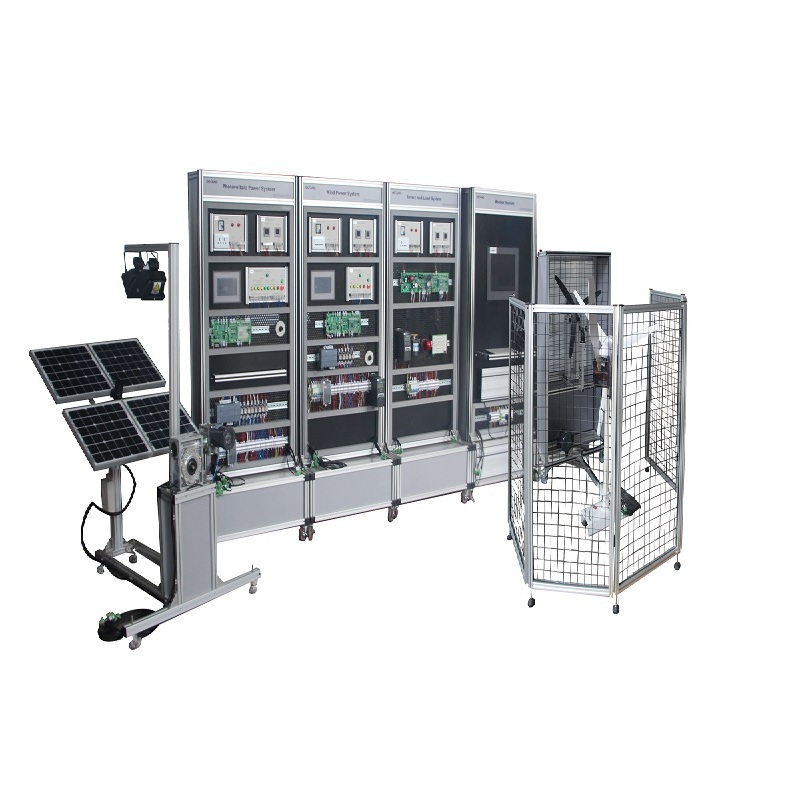
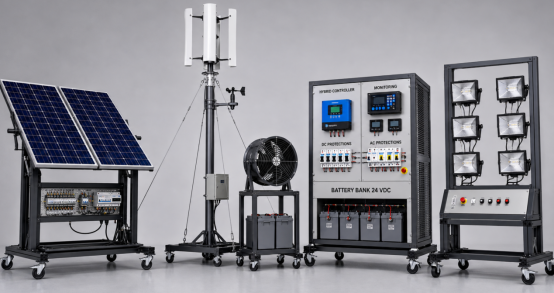
The integrated wind-solar hybrid power generation training system is designed to meet the practical training needs of new energy-related majors. It is a mobile, comprehensive experimental platform comprising photovoltaic power generation, wind power generation, energy storage, control, inverter, distribution protection, load monitoring, and online monitoring. The system can demonstrate the synergistic utilization of wind and solar energy under safe, visual, and operable conditions.
I, Equipment Overview
The integrated wind-solar hybrid power generation training system is designed to meet the practical training needs of new energy-related majors. It is a mobile, comprehensive experimental platform comprising photovoltaic power generation, wind power generation, energy storage, control, inverter, distribution protection, load monitoring, and online monitoring. The system can demonstrate the synergistic utilization of wind and solar energy under safe, visual, and operable conditions.
Based on real, operational photovoltaic and vertical wind power generation units, the system covers the complete energy chain from power generation to control, energy storage, inversion, power consumption, and monitoring. It adopts a modular, split-type metal frame design, with key components housed on a movable base for easy access to the training room, teaching demonstrations, maintenance, and group training. Typical loads such as resistive, inductive, and lighting loads are included, along with wind source simulation and wind speed/direction measurement instruments to meet the needs of multi-condition experiments. It is suitable for cognitive teaching, principle verification, wiring training, control strategy comparison, operation monitoring, fault analysis, and comprehensive assessment.
II, Module introduction
1. Photovoltaic solar power station
● Two monocrystalline solar photovoltaic panels, each with a power output of 450W ,
● Adjustable tilt angle metal structure
● Standardized industrial accessories for panel mounting
● A panel box equipped with standardized connectors for connecting to the control station.
● Accessories required to ensure normal operation: cables, MC4 connectors, circuit breakers, fuse holders, and fuses .
2. Wind Station
● Metal structure, with a detachable portable mast (3–5 meters)
● 400W Rated Power Vertical Axis Wind Turbine
● Tensioner/Rigging Kit
● A panel box equipped with standardized connectors for connecting to the control station.
● Accessories required for proper operation: cables, MC4 connectors, circuit breakers, fuse holders, fuses.
● RS485 communication wind speed sensor
3. Artificial lighting stations
● Adjustable-angle lamps with adjustable tilt: 2 halogen lamps (1000 W each), 4 LED lamps (25 W each)
● Metal structure (approximate dimensions L×W×H: 1200×700×1800 mm)
4. Artificial wind farm station
● Battery-powered axial air blower, brushless motor and axial fan
● Comes with 2 batteries, providing up to 1 hour of continuous operation.
5. Control Station
● 1 MPPT photovoltaic charging controller
● 1 PWM wind-solar hybrid charging controller
● 1 Hybrid wind-solar charging controller
● One touchscreen for system electronic data acquisition
● One power quality analyzer is used to measure power, voltage, and current.
● 2 x 24V (25.6V nominal)/100AH lithium batteries
● One 3kW sine wave inverter
● AC circuit breakers, DC circuit breakers, busbars
● Safety features: Continuous grounding, Thermomagnetic circuit breaker, residual current device (RCD/GFCI), surge protector, emergency stop button
● Load: Resistive load (Incandescent lamp: 100 W; Heating element: 300W); Inductive load (0.5 HP three-phase motor [4 poles, 220 V], single-phase input frequency converter [VFD]; 0.5 HP single-phase motor).
● Single-phase power sockets, industrial three-phase power sockets
6. All unit metal structures
● Oven-baking electrostatic powder coating
● Square tube
● Heavy-duty 4-inch swivel wheels
● Metal panel
III, Main component configuration list
Serial Number | name | Specifications | quantity | unit |
1 |
Solar panels | ● Maximum power: 450 W ● Operating voltage: 36 V ● Open-circuit voltage: 43.2 V ● Peak current: 12.5 A ● Short-circuit current: 14 A ● Cell conversion efficiency: ≥25.1% ● Operating temperature range: -40°C – +85° C |
2 |
piece |
2 |
Vertical axis wind turbine | ● Rated power: 400W ● Rated wind speed: 11.5m/s ● Rated voltage: 24V ● Starting wind speed: 2m/s ● Safe wind speed: 35m/s |
1 |
indivual |
|
| ● Braking method: Electromagnetic unloading ● Generator type: Three-phase AC permanent magnet motor ● Number of leaves: 3 ● Operating temperature range: -20 ℃ to + 60℃ |
|
|
3 |
Anemometer Wind speed and direction sensor | ● Anemometer: Cup-type + wind vane ● Rated voltage: 6–24 VDC ● Wind speed range: 0–50 m/s ● Wind speed accuracy: ±0.5 m/s ● Starting wind speed: 0.2–0.8 m/s ● Wind speed resolution: 0.1 m/s ● Wind direction range: 0–360° ● Wind direction resolution: ±22.5° ● Operating environment: –20°C–+80°C ● RS485 Modbus communication interface |
1 |
set |
4 |
Hybrid Wind-Solar Charging Controller | ● Rated input power for wind power: 400W ● Rated input voltage for wind power: 24V ● Rated input power of photovoltaic power: 900W ● Maximum open-circuit input voltage for photovoltaic systems: 48V ● Rated input current for photovoltaic power: 38A ● Communication interface: RS485 ● Photovoltaic tracking method: MPPT
|
1 |
set |
5 |
PWM Wind-Solar Hybrid Charging Controller | ● Rated input power for wind power: 400W ● Rated input voltage for wind power: 24V ● Rated input power of photovoltaic power:900W ● Maximum open-circuit input voltage for photovoltaic systems: 48V ● Rated input current for photovoltaic power: 38A ● Communication interface: RS485 ● Photovoltaic tracking method: PWM |
1 |
set |
6 |
MPPT Photovoltaic Charging Controller |
● Maximum photovoltaic input power: 1040 W ● Maximum photovoltaic open-circuit input voltage: 92 V ● Maximum photovoltaic input current: 40 A ● Photovoltaic tracking method: MPPT |
1 |
set |
7 |
Off-grid Sine wave inverter | ● Continuous output power: 3000W ● Peak Power: 6000W (>= 2 x Nominal Power) ● Output voltage: 220VAC (±3%); 230VAC (-6%~+3%); 240VAC (-9%~+3%) ● Output frequency: 50/60Hz ± 0.2% ● Output waveform: Pure sine wave ● Input rated voltage: 24V ● Input voltage range: 21.6 ~ 32.0VDC ● USB output interface ● RS485 communication interface |
1 |
set |
|
| ● THD < 3% protection (overload, short circuit, low/high DC voltage) |
|
|
7 | lithium batteries | ● Rated voltage: 24 V (25.6V Nominal) ● Rated capacity: 100AH |
2 |
piece |
8 |
Axial flow fan | ● Rated power: 750W ● Rated speed: 3800 r/min ● Rated voltage: 24V ● Total pressure: 300Pa ● Minimum air volume: 500 m³ /h ● Maximum air volume: 20000 m³ /h ● Noise level: 80 dB(A) ● Theoretical exit wind speed: 28 m/s ( 100 km/h ) ● Motor type: Brushless motor |
1 |
set |
9 |
halogen lamp | ● Rated power: 1000W ● Rated voltage: 220V/AC ● Equipped with a dimming switch |
2 |
Only |
10 |
LED lights | ● Rated power: 25W ● Rated voltage: 220VAC ● Equipped with a dimming switch |
4 |
Only |
11 |
touchscreen | ● Screen size: 10 inches ● Communication interface: RS485 ● Collect RS485 data display |
1 |
Set |
12 |
Power quality analyzer | ● Single-phase AC testing instruments ● Measure parameters such as current, voltage, power, power factor, and electrical energy in the power grid. ● Communication interface: RS485 |
1 |
set |
13 |
Resistive Load (incandescent lamp) |
● Rated voltage: 220 VAC ● Rated power: 100 W |
1 |
piece |
14 |
Heating pad |
Rated voltage: 220V/AC Rated power: 300W |
1 |
piece |
15 |
Inductive Load Three phase asynchronous motor | Rated power: 0.5 HP Rated speed: 1400r/min Rated voltage: 220VAC Rated current: 1.1A |
1 |
piece |
16 |
Single phase motor | Rated power: 0.5 HP Rated speed: 1400r/min Rated voltage: 220VAC Rated current: 1.1A |
1 |
piece |
17 |
Frequency Converter |
Rated power: 0.37KW Rated power supply: 200-240VAC |
1 |
piece |
IV. Experimental Project Reference
1. System Cognition and Safety Specifications
2. Photovoltaic module parameters and wiring
3. The Influence of Photovoltaic Tilting Angle and Sunlight
4. Comparison of MPPT and PWM control
5. Fan output characteristic test
6. Mast and Fan Installation Training
7. Wind-solar hybrid power supply
8. Inverter operation and power quality
9. Characteristics of resistive and inductive loads
10. VFD Drive and Motor Speed Control
11. Data Acquisition and Modbus Communication